


[Featured Image Placeholder]
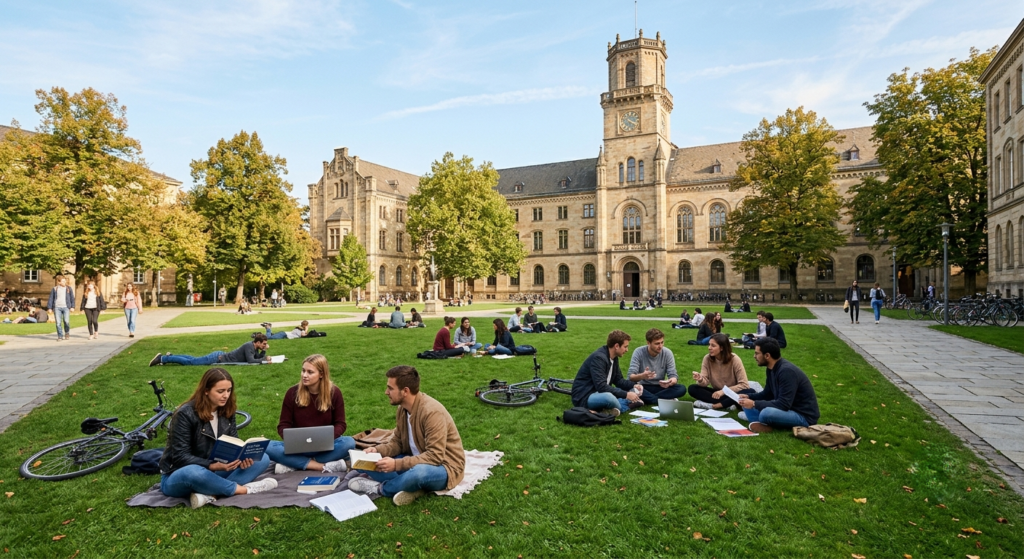
![Group of happy international students walking past a historical German university hall]
AI Image Prompt: A vibrant, wide-angle editorial photograph of diverse international university students carrying backpacks and laptops, smiling and conversing outside a landmark German university building. Soft morning sun, autumn foliage, stone architecture, photorealistic 4k detail.
Meta Description:
Is college really free in Germany? Discover how tuition-free study works, regional exceptions, hidden semester fees, and real living costs for non-EU students.
Is College Really Free in Germany? Top Universities & Hidden Costs Explained
Germany has earned an unparalleled reputation among international students as a top-tier global study destination. The primary reason? The promise of zero tuition fees at world-renowned public institutions. For many, the ability to earn a prestigious European degree without taking on thousands of dollars in student debt sounds like a marketing myth.
So, is college really free in Germany, or are there hidden conditions prospective applicants should watch out for?
The straightforward answer is yes, but with crucial qualifications. While public universities across 15 of Germany’s 16 federal states do not charge classic tuition fees for undergraduate or consecutive Master’s degrees, studying in Germany is not entirely free. International scholars must budget for administrative semester contributions, health insurance, daily living expenses, and specific regional policy exceptions.
Key Takeaways
- Zero Tuition at Public Universities: Most public universities in Germany do not charge tuition fees for domestic or international students pursuing Bachelor’s or consecutive Master’s degrees.
- Regional & University Exceptions: Institutions in Baden-Württemberg charge non-EU international students €1,500 per semester, and individual universities like Technical University of Munich (TUM) have reintroduced tuition fees for non-EU scholars.
- Mandatory Semester Contribution: Students pay a compulsory Semesterbeitrag (€150 to €400 per term) that covers administrative fees, student union funding, and local public transit passes.
- Proof of Living Funds (Sperrkonto): To receive a German student visa, non-EU/EEA nationals must open a blocked account containing at least €11,904 per year to support daily living expenses.
- Part-Time Work Allowance: Non-EU students are legally permitted to work up to 140 full days (or 280 half days) per calendar year to supplement their income.
How Germany’s Tuition-Free University System Works
In October 2014, Germany’s state governments officially abolished tuition fees across all public higher education institutions. The core social vision behind this reform was that higher education should be treated as a accessible public service rather than a commercial product.
This policy applies equally to domestic German citizens, EU residents, and non-EU international students. When asking is college really free in Germany, it helps to distinguish between tuition charges and daily operational expenses. You will not receive a bill for course registration, lecture attendance, or exam grading at a state-run university.
[External Link: Official DAAD Website on Higher Education in Germany]
Public vs. Private Universities in Germany
To avoid costly misunderstandings, applicants must understand the distinction between public and private institutions in Germany:
- Public Universities (Staatliche Hochschulen): State-funded institutions serving over 90% of all university students in the country. These institutions offer tuition-free degree programs.
- Private Universities (Private Hochschulen): Independently funded institutions that set their own tuition rates, often charging between €5,000 and €20,000 per academic year.

Top Tuition-Free Universities in Germany
Germany is home to numerous globally ranked public research institutions where qualified students can study without paying tuition:
- Ludwig Maximilians University of Munich (LMU Munich): Ranked among Europe’s premier research hubs, excelling in humanities, law, natural sciences, and medicine.
- Heidelberg University: Founded in 1386, this historic university is world-renowned for medicine, life sciences, and physics.
- Humboldt University of Berlin & Free University of Berlin (FU Berlin): Elite public institutions located in the heart of Germany’s capital, recognized for arts, humanities, political science, and social studies.
- RWTH Aachen University: A leading technical university in Europe, highly regarded by global employers for engineering, computer science, and technology.
- University of Göttingen: A renowned public university famous for natural sciences, mathematics, and research opportunities.
Exceptions: When College is NOT Free in Germany
While tuition-free access remains the standard policy across most of the nation, there are notable exceptions that international students need to know before applying.
1. Non-EU Students in Baden-Württemberg
In 2017, the southwestern state of Baden-Württemberg reintroduced tuition fees for non-EU/EEA international students. If you attend public universities in cities like Heidelberg, Stuttgart, Freiburg, or Tübingen, you will pay €1,500 per semester (€3,000 per year).
2. Technical University of Munich (TUM) Tuition Fees
Starting in the 2024/2025 academic year, the Technical University of Munich introduced per-semester tuition fees for incoming non-EU/EEA applicants. Fees range from €2,000 to €3,000 per semester for Bachelor’s degrees and €4,000 to €6,000 per semester for Master’s programs.
3. Non-Consecutive Master’s & Executive Degrees
If you enroll in a Master’s degree that does not directly connect to your undergraduate field of study (a non-consecutive degree) or pursue specialized executive programs (like an MBA), public universities are legally allowed to charge customized tuition fees.
Hidden Costs of Studying in Germany Explained
When calculating your total study budget, you must factor in mandatory university charges and baseline living expenses.
| Expense Type | Cost Range | Description & Purpose |
| Semester Contribution (Semesterbeitrag) | €150 – €400 | Paid twice per year; covers administration, student services, and local transport |
| Public Health Insurance (Krankenkasse) | ~€130 – €140/month | Mandatory coverage for enrolled university students under age 30 |
| German Blocked Account (Sperrkonto) | €11,904/year | Minimum required financial proof for non-EU student visa issuance |
| Housing & Accommodation | €350 – €750/month | Shared apartments (WG) or student dormitories (Studentenwohnheim) |
| Food & Personal Expenses | €250 – €400/month | Groceries, clothing, phone plans, internet, and leisure activities |
What is the Semester Contribution (Semesterbeitrag)?
Every student enrolled at a German public university must pay a Semesterbeitrag at the start of each term. This is not a tuition fee. Instead, it breaks down into three key areas:
- Administration Charges: Covers student registration, enrollment processing, and academic administration.
- Student Union Support (Studierendenwerk): Funds campus cafeterias (Mensa), housing management, and student welfare services.
- Public Transit Ticket (Semesterticket): In most university cities, this fee grants you unlimited regional transportation (buses, trams, S-Bahn, and regional trains) for the full six-month semester.

Living Costs & The German Blocked Account (Sperrkonto)
Living costs represent the largest expense for international scholars in Germany. To secure a student visa, non-EU/EEA applicants must provide official proof of financial resources (Finanzierungsnachweis).
The standard method to fulfill this requirement is opening a German Blocked Account (Sperrkonto). Prospective students must deposit the required annual sum before traveling to Germany. Once registered in the country, the bank releases a set monthly allowance.
- Required Annual Deposit: €11,904
- Monthly Allowance Release: €992
Your choice of city will dramatically affect your monthly spending. Metropolises like Munich, Frankfurt, and Hamburg carry higher rent costs, while student cities in eastern Germany, such as Leipzig, Dresden, or Jena, offer significantly lower living costs.
[Internal Link: Ultimate Guide to Opening a Blocked Account for German Student Visas]
Frequently Asked Questions (FAQs)
Is college really free in Germany for non-EU international students?
Yes, public universities in 15 out of 16 German states offer tuition-free study to all enrolled students regardless of citizenship. Key exceptions include public universities in the state of Baden-Württemberg (€1,500/semester) and specific universities like TU Munich that charge non-EU international fees.
How much money do I need to study in Germany for free?
While tuition at public universities is free, you need approximately €900 to €1,200 per month to cover rent, groceries, mandatory health insurance, study materials, and semester contributions. To satisfy visa rules, non-EU applicants must place €11,904 in a blocked account.
Can I work part-time in Germany to support my studies?
Yes. Non-EU/EEA students are legally allowed to work up to 140 full days or 280 half days per calendar year. On-campus academic assistant roles (HiWi) often do not count toward this limit.
Do I need to speak fluent German to study at a public university?
Not always. While most undergraduate degrees require German language proficiency (B2/C1 level), German public universities offer hundreds of tuition-free Master’s degrees taught entirely in English.
Conclusion
So, is college really free in Germany? The core academic instruction at public universities is indeed tuition-free, making Germany one of the most cost-effective study abroad destinations in the world. However, earning your degree still requires clear financial planning for living expenses, mandatory health insurance, and semi-annual semester contributions. By picking the right region, securing accommodation early, and maintaining your blocked account, you can obtain a high-value European degree without taking on heavy financial burdens.