


Navigating higher education in Germany requires balancing two critical components: securing academic admission and fulfilling legal visa conditions. While Germany’s public universities offer virtually tuition-free education across most federal states, gaining acceptance demands careful preparation of your academic credentials and financial proof.
Successfully managing German university applications and blocked accounts depends on following precise timelines and fulfilling specific federal requirements. By coordinating your admissions portal submissions with your financial deposit, you can eliminate application delays and ensure a smooth transition to studying in Germany.
Key Takeaways
- Dual-Track Preparation: Securing a German student visa requires both an official university admission letter and verified proof of financial resources (Sperrkonto).
- Mandatory Deposit Threshold: The federal minimum requirement for a German blocked account is €11,904 per year (€992 per month).
- Credential Evaluation Portal: Many public universities require foreign academic certificates to be evaluated by uni-assist to verify Higher Education Entrance Qualification (HZB) equivalence.
- Visa Application Channels: Non-EU applicants submit official visa requests through the official Consular Services Portal (digital.diplo.de) or local German embassies.
- Payout Structure: Upon arrival in Germany and completion of address registration (Anmeldung), the blocked account disburses monthly living funds into a local checking account (Girokonto).
Navigating German University Applications
Before setting up your visa finances, you must secure an offer of admission from a recognized German institution. Understanding entry pathways prevents unnecessary rejections during document review.
1. Qualification Assessment (HZB & Anabin)
Your foreign secondary school certificate or university transcripts must meet the criteria for a Higher Education Entrance Qualification (Hochschulzugangsberechtigung or HZB).
- Direct Admission: Your qualifications match German Abitur standards, allowing direct application to Bachelor’s or Master’s programs.
- Indirect Admission: If your secondary diploma is not directly equivalent, you must enroll in a one-year preparatory foundation course (Studienkolleg) and pass the Feststellungsprüfung (FSP) entrance examination.
2. Processing Through uni-assist vs. Direct Submission
- uni-assist Applications: Evaluates international certificates for over 180 German universities. Applicants upload certified translations, CVs, and language scores (TestDaF, DSH, IELTS, or TOEFL).
- Direct University Portals: Select institutions (e.g., TU Munich, RWTH Aachen) manage international admissions directly through their internal application portals.
[External Link: Official DAAD University Application & Admission Guide]

Mastering the German Blocked Account (Sperrkonto)
A blocked account is a legally binding financial safeguard required by the German Federal Foreign Office (Auswärtiges Amt). It proves to embassy officials that you have sufficient funds to cover your basic living expenses without depending on state assistance.
Blocked Account Requirements & Figures
| Requirement Parameter | Federal Standard | Notes & Guidelines |
| Total Annual Deposit | €11,904 | Standard requirement for a 12-month student visa. |
| Monthly Disbursal Limit | €992 / month | Capped monthly transfer into your local German bank account. |
| BAföG Reference Basis | Federal Living Standard | Based on official German student financial aid benchmarks. |
| Approved Setup Timeframe | 4 to 6 weeks before visa | Recommended window to complete transfer and receive confirmation. |
[Internal Link: Step-by-Step Guide on Blocked Account Providers in Germany]
Combining Admissions & Visa Funding into a Timeline
To successfully manage German university applications and blocked accounts, follow a structured step-by-step preparation schedule:
- 6–9 Months Before Intake: Research universities on DAAD, verify HZB status on the Anabin database, and take required language exams (IELTS/TOEFL or TestDaF/DSH).
- 3–5 Months Before Intake: Submit completed application files via uni-assist or direct university portals before intake deadlines (July 15 for Winter semester; January 15 for Summer semester).
- 2–3 Months Before Intake: Upon receiving your admission offer letter (Zulassungsbescheid), select an approved digital blocked account provider (such as Expatrio or Fintiba).
- 1–2 Months Before Intake: Transfer €11,904 plus setup fees, retrieve your official blocking confirmation letter (Sperrbescheinigung), and schedule your visa appointment.
Frequently Asked Questions (FAQs)
Why are German university applications and blocked accounts linked?
German embassies require both proof of academic eligibility (admissions letter) and proof of financial capability (blocked account confirmation) before issuing a national student visa. Without both components verified, visa issuance cannot proceed.
Can I deposit more than €11,904 into my blocked account?
Yes. You can deposit additional buffer funds to cover extra living costs, setup fees, or extended stay requirements. However, the standard minimum monthly payout remains capped at €992 unless authorized by local immigration authorities (Ausländerbehörde).
How do I access my blocked account funds after arriving in Germany?
Once you arrive in Germany, complete your city address registration (Anmeldung), open a local current account (Girokonto), and submit your registration certificate to your blocked account provider to activate monthly transfers.
Conclusion
Mastering German university applications and blocked accounts is the essential gateway to earning an internationally respected degree tuition-free. By meticulously organizing your academic credentials for uni-assist and funding your mandatory €11,904 blocked account in advance, you position yourself for a smooth visa approval and a stress-free start to your academic journey in Germany.
Focus Keyword: German university applications and blocked accounts
Category: Visas & Financial Preparation
[Featured Image Placeholder]
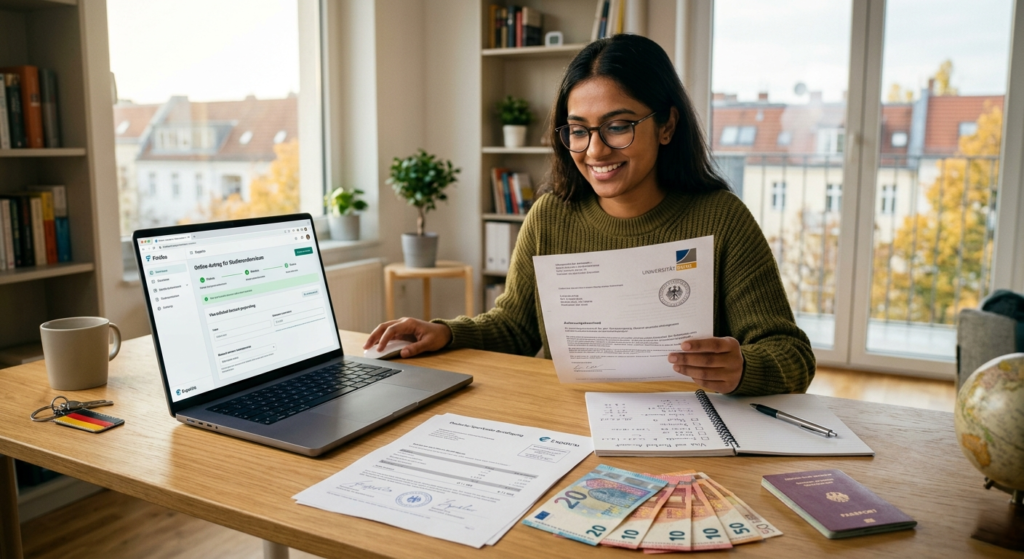
![Modern international student working with laptop, university acceptance letter, and banking documents]
AI Image Prompt: A high-resolution, cinematic portrait of an ambitious international student sitting at a brightly lit wooden desk in a modern studio apartment. On the table lies an official university acceptance letter with German letterhead, a laptop showing an online application dashboard, and neatly stacked financial planning documents. Natural daylight, warm ambiance, crisp details, 4k editorial style.
Meta Description:
Master German university applications and blocked accounts. Learn HZB rules, uni-assist steps, Sperrkonto funding of €11,904, and student visa tips.
Master Your German University Applications & Blocked Accounts
Navigating higher education in Germany requires balancing two critical components: securing academic admission and fulfilling legal visa conditions. While Germany’s public universities offer virtually tuition-free education across most federal states, gaining acceptance demands careful preparation of your academic credentials and financial proof.
Successfully managing German university applications and blocked accounts depends on following precise timelines and fulfilling specific federal requirements. By coordinating your admissions portal submissions with your financial deposit, you can eliminate application delays and ensure a smooth transition to studying in Germany.
Key Takeaways
- Dual-Track Preparation: Securing a German student visa requires both an official university admission letter and verified proof of financial resources (Sperrkonto).
- Mandatory Deposit Threshold: The federal minimum requirement for a German blocked account is €11,904 per year (€992 per month).
- Credential Evaluation Portal: Many public universities require foreign academic certificates to be evaluated by uni-assist to verify Higher Education Entrance Qualification (HZB) equivalence.
- Visa Application Channels: Non-EU applicants submit official visa requests through the official Consular Services Portal (digital.diplo.de) or local German embassies.
- Payout Structure: Upon arrival in Germany and completion of address registration (Anmeldung), the blocked account disburses monthly living funds into a local checking account (Girokonto).
Navigating German University Applications
Before setting up your visa finances, you must secure an offer of admission from a recognized German institution. Understanding entry pathways prevents unnecessary rejections during document review.
1. Qualification Assessment (HZB & Anabin)
Your foreign secondary school certificate or university transcripts must meet the criteria for a Higher Education Entrance Qualification (Hochschulzugangsberechtigung or HZB).
- Direct Admission: Your qualifications match German Abitur standards, allowing direct application to Bachelor’s or Master’s programs.
- Indirect Admission: If your secondary diploma is not directly equivalent, you must enroll in a one-year preparatory foundation course (Studienkolleg) and pass the Feststellungsprüfung (FSP) entrance examination.
2. Processing Through uni-assist vs. Direct Submission
- uni-assist Applications: Evaluates international certificates for over 180 German universities. Applicants upload certified translations, CVs, and language scores (TestDaF, DSH, IELTS, or TOEFL).
- Direct University Portals: Select institutions (e.g., TU Munich, RWTH Aachen) manage international admissions directly through their internal application portals.
[External Link: Official DAAD University Application & Admission Guide]
[Image Placeholder 1]
![Student reviewing academic transcripts and application portals on a laptop]
AI Image Prompt: A clean, top-down perspective of a student organized at a desk. An open laptop displays an admissions portal with green verification checks. Next to the laptop are neatly arranged academic certificates, a German dictionary, and a cup of coffee. Warm daylight, sharp focus, 4k.
Mastering the German Blocked Account (Sperrkonto)
A blocked account is a legally binding financial safeguard required by the German Federal Foreign Office (Auswärtiges Amt). It proves to embassy officials that you have sufficient funds to cover your basic living expenses without depending on state assistance.
Blocked Account Requirements & Figures
| Requirement Parameter | Federal Standard | Notes & Guidelines |
| Total Annual Deposit | €11,904 | Standard requirement for a 12-month student visa. |
| Monthly Disbursal Limit | €992 / month | Capped monthly transfer into your local German bank account. |
| BAföG Reference Basis | Federal Living Standard | Based on official German student financial aid benchmarks. |
| Approved Setup Timeframe | 4 to 6 weeks before visa | Recommended window to complete transfer and receive confirmation. |
[Internal Link: Step-by-Step Guide on Blocked Account Providers in Germany]
[Image Placeholder 2]
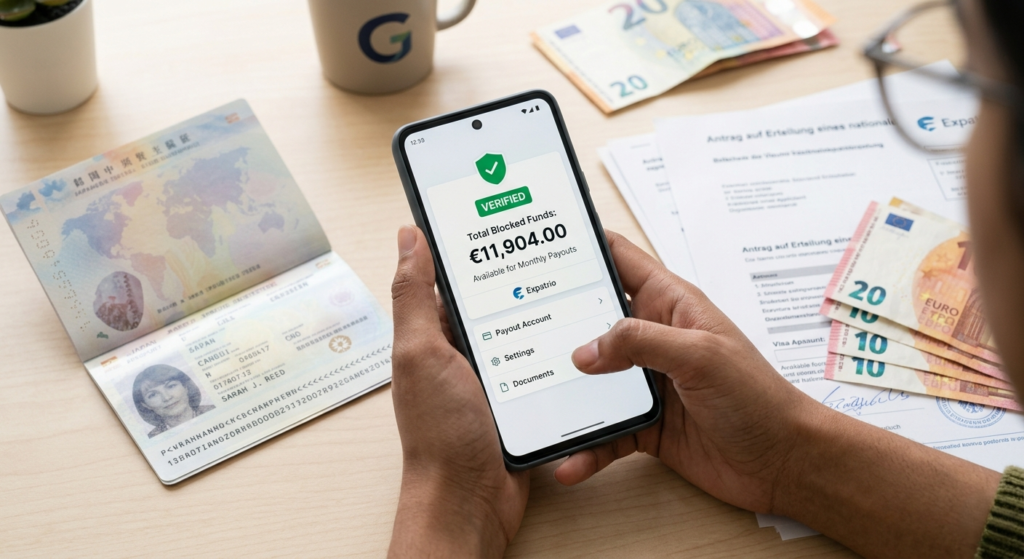
![Digital banking interface on smartphone showing blocked account confirmation]
AI Image Prompt: A close-up shot of hands holding a modern smartphone displaying an official digital blocked account confirmation screen with a green verified badge and ‘€11,904.00’ balance. In the background, a desk features an open passport and German student visa application forms. Professional corporate lighting.
Combining Admissions & Visa Funding into a Timeline
To successfully manage German university applications and blocked accounts, follow a structured step-by-step preparation schedule:
- 6–9 Months Before Intake: Research universities on DAAD, verify HZB status on the Anabin database, and take required language exams (IELTS/TOEFL or TestDaF/DSH).
- 3–5 Months Before Intake: Submit completed application files via uni-assist or direct university portals before intake deadlines (July 15 for Winter semester; January 15 for Summer semester).
- 2–3 Months Before Intake: Upon receiving your admission offer letter (Zulassungsbescheid), select an approved digital blocked account provider (such as Expatrio or Fintiba).
- 1–2 Months Before Intake: Transfer €11,904 plus setup fees, retrieve your official blocking confirmation letter (Sperrbescheinigung), and schedule your visa appointment.
[Image Placeholder 3]
![Student walking happily outside a German university campus holding documents]
AI Image Prompt: A cheerful international student walking outdoors across a scenic university campus in Germany with historical stone buildings in the background. The student holds a document folder and backpack, enjoying a sunny afternoon. Authentic high dynamic range photograph.
Frequently Asked Questions (FAQs)
Why are German university applications and blocked accounts linked?
German embassies require both proof of academic eligibility (admissions letter) and proof of financial capability (blocked account confirmation) before issuing a national student visa. Without both components verified, visa issuance cannot proceed.
Can I deposit more than €11,904 into my blocked account?
Yes. You can deposit additional buffer funds to cover extra living costs, setup fees, or extended stay requirements. However, the standard minimum monthly payout remains capped at €992 unless authorized by local immigration authorities (Ausländerbehörde).
How do I access my blocked account funds after arriving in Germany?
Once you arrive in Germany, complete your city address registration (Anmeldung), open a local current account (Girokonto), and submit your registration certificate to your blocked account provider to activate monthly transfers.
Conclusion
Mastering German university applications and blocked accounts is the essential gateway to earning an internationally respected degree tuition-free. By meticulously organizing your academic credentials for uni-assist and funding your mandatory €11,904 blocked account in advance, you position yourself for a smooth visa approval and a stress-free start to your academic journey in Germany.