

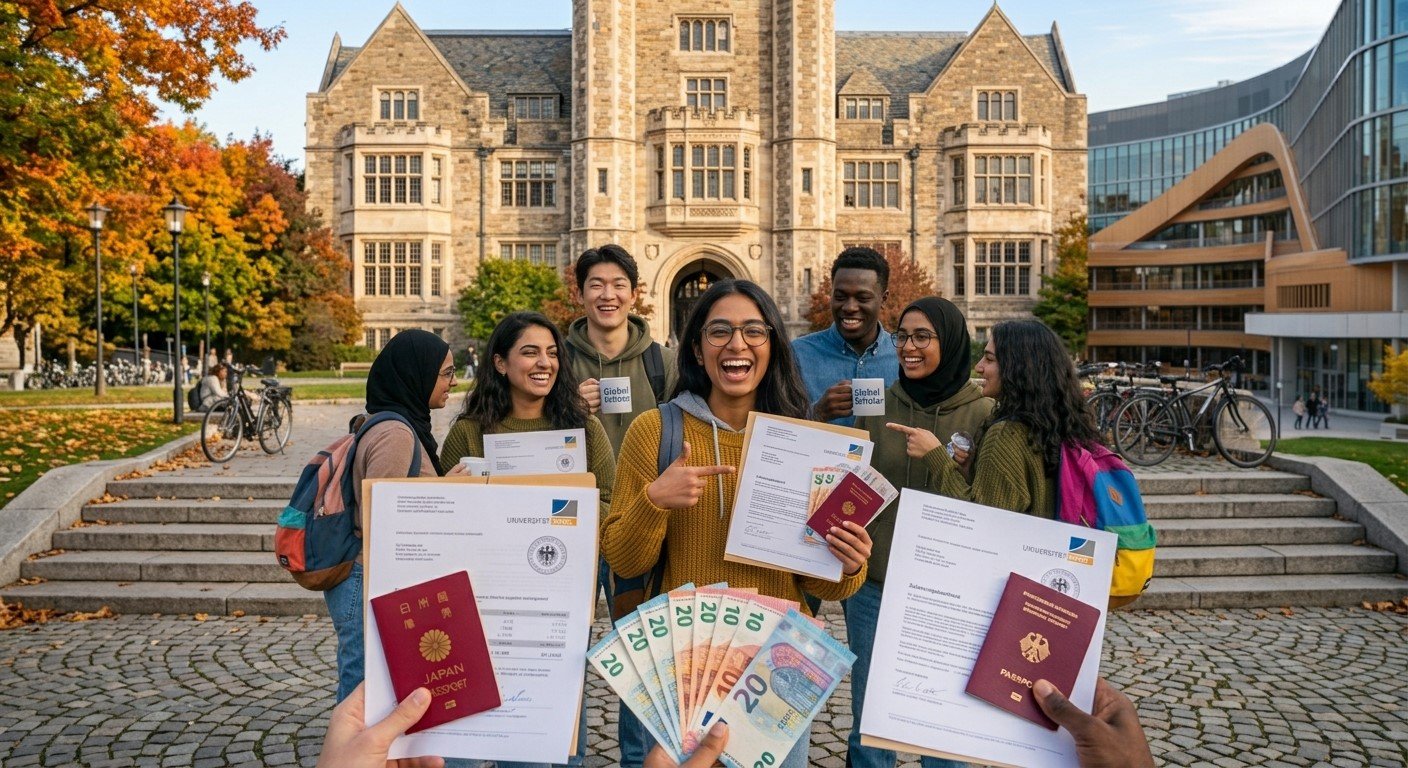
Germany has emerged as one of the premier global study destinations for international students seeking world-class academic standards without staggering tuition debt. Thanks to government funding across state institutions, thousands of global scholars pursue undergraduate and postgraduate degrees each year completely tuition-free.
If you aim to study in Germany without tuition fees, mastering the admission timelines, qualification prerequisites, and financial verification standards is essential. This step-by-step framework outlines everything required to transition smoothly from applicant to enrolled student.
Key Takeaways
- Zero Tuition Charge: Public universities in 15 of 16 German federal states charge no tuition fees for domestic and international students in most Bachelor’s and consecutive Master’s degree programs.
- Mandatory Semester Fee (Semesterbeitrag): Students pay a small administrative contribution ranging between €100 and €400 per term, which usually grants a local public transit pass.
- Proof of Financial Resources (Sperrkonto): Non-EU applicants must deposit €11,904 per year (€992 per month) into an approved German blocked account as living cost proof for the student visa.
- Degree Verification Framework: Educational qualifications must be recognized via Anabin or validated through a preparatory Studienkolleg course.
- Work Opportunities & Post-Study Residence: Students can work up to 140 full days per year while studying, followed by an 18-month job-seeking visa upon graduation.
Understanding the German Higher Education System
Public higher education institutions in Germany are state-funded and focus heavily on practical skill acquisition alongside academic excellence.
University Types & Degree Tracks
- Research Universities (Universitäten): Focused on theoretical knowledge, scientific research, and academic methodologies—ideal for students intending to earn doctoral degrees.
- Universities of Applied Sciences (Fachhochschulen / TH): Emphasize hands-on technical skills, industry projects, and practical field work.
- Colleges of Art, Film, and Music (Kunst- und Musikhochschulen): Highly specialized institutes focused on creative talents, requiring portfolio submissions and entrance exams.
[External Link: Official DAAD International Degree Database]

Admissions Roadmap: From Credentials to Acceptance
To successfully study in Germany without tuition fees, you must systematically prove academic qualification and satisfy language requirements.
Secondary Qualification Equivalency (HZB)
Your foreign high school certificate or previous degree transcript must match the German Higher Education Entrance Qualification (Hochschulzugangsberechtigung).
- Direct Admission: Your diploma directly qualifies you for university entry.
- Indirect Admission: You must take a one-year foundation program (Studienkolleg) and pass the Feststellungsprüfung (FSP) prior to university enrollment.
Submission via uni-assist
Many public universities streamline foreign application processing through uni-assist, a centralized clearing service that evaluates transcripts, verifies authentic copies, and converts international grades into the German GPA system.
[Internal Link: Detailed Guide on uni-assist Application Procedures]

Budgeting & Financial Requirements for Your Visa
While tuition costs are waived, non-EU students must provide official proof of financial self-sufficiency to obtain a German student visa.
| Expense Category | Required Deposit / Cost | Description & Key Details |
| Annual Blocked Account | €11,904 | Mandatory proof of funds deposited prior to visa application. |
| Monthly Disbursement | €992 / month | Released monthly to cover living, housing, and food expenses. |
| Semester Contribution | €100 – €400 / term | Covers administration fees and regional public transit. |
| Health Insurance | ~€110 – €130 / month | Statutory health coverage (GKV) required for matriculation. |

Frequently Asked Questions (FAQs)
Can I study in Germany without tuition fees if I only speak English?
Yes. German public universities offer thousands of fully English-taught Bachelor’s and Master’s degree programs, particularly in Engineering, Computer Science, and International Business. Standardized tests like IELTS or TOEFL satisfy the language requirement.
How do I open a blocked account to study in Germany without tuition fees?
You can set up a German blocked account online through official providers such as Expatrio, Fintiba, or Coracle. Once transferred, the bank provides an official document showing the €11,904 deposit for your visa interview.
Are there any states in Germany that charge tuition fees?
Yes. Baden-Württemberg charges non-EU international students €1,500 per semester at public institutions. Public institutions in the other 15 federal states remain tuition-free.
Conclusion
The opportunity to study in Germany without tuition fees provides international scholars with unparalleled access to top-tier academic training without crippling debt. By checking your qualification eligibility (HZB), submitting verified applications via uni-assist, and funding your €11,904 blocked account, you can confidently turn your goal of studying at a renowned German university into reality.