

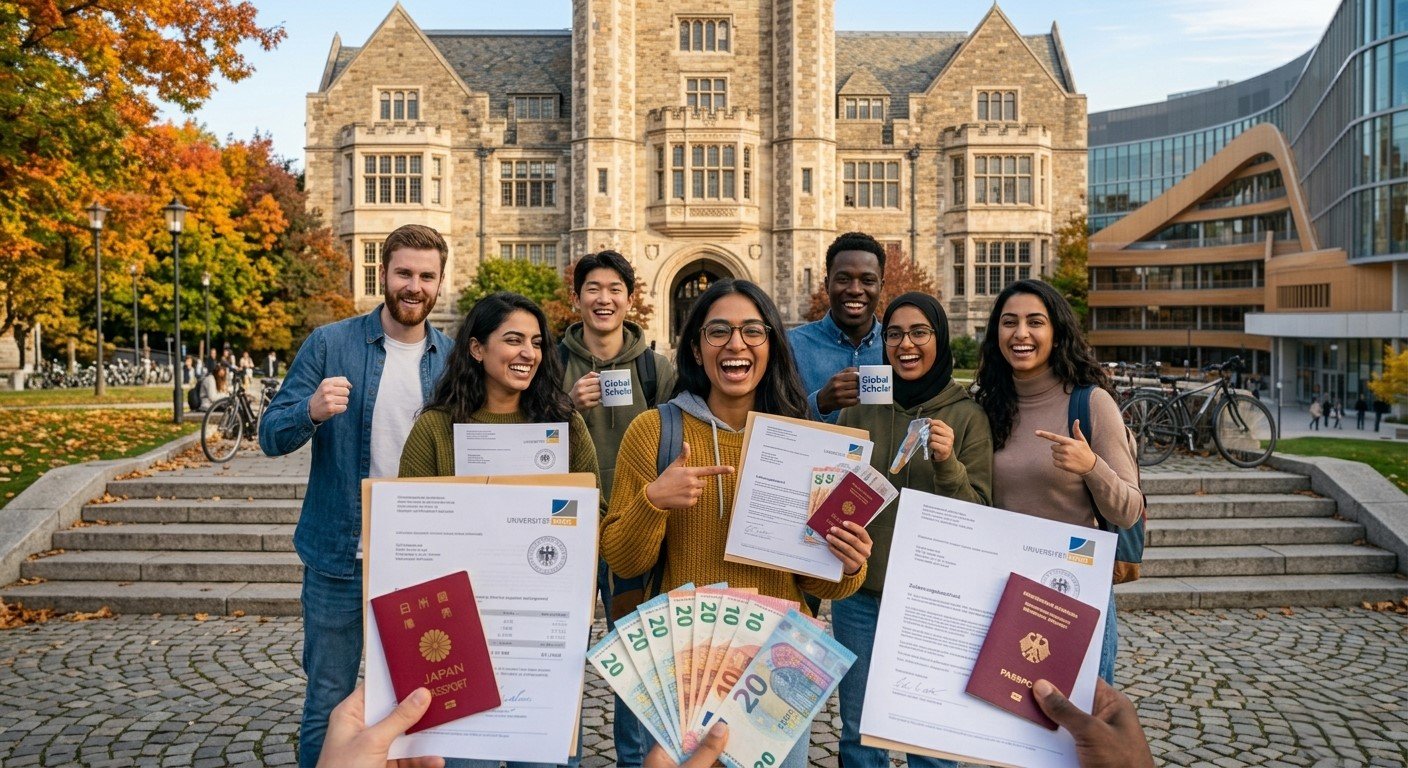
Germany has established itself as one of the world’s premier destinations for international scholars. By offering tuition-free study programs across hundreds of public institutions to both domestic and foreign nationals, the country has opened doors for thousands of global talents each year.
Navigating the pathways to free education in Germany requires understanding eligibility guidelines, university submission systems, and official student visa protocols. This comprehensive guide breaks down every step necessary to transition from candidate to enrolled student at a German public university.
Key Takeaways
- Zero Tuition Policy: Over 300 public universities offer Bachelor’s and consecutive Master’s degrees without charging regular tuition fees, regardless of your citizenship.
- Minimal Semester Fees: Students pay a nominal semester contribution (Semesterbeitrag) ranging between €100 and €400, which typically covers administrative expenses and a public transit pass.
- Financial Standard: To secure a national student visa, non-EU applicants must open a blocked account (Sperrkonto) containing €11,904 per year (€992 per month).
- English-Taught Options: More than 2,000 degree programs are taught completely in English across various disciplines.
- Post-Graduation Rights: Graduates receive an 18-month post-study work visa to seek employment within the German job market.
Understanding Public University Funding Models
The foundation of free education in Germany rests on state-funded higher education. The federal government views higher education as a public good that drives innovation and economic growth.
How Public Institutions Function
Public universities (Universitäten) and universities of applied sciences (Fachhochschulen) receive funding from regional state budgets rather than student tuition.
- Consecutive Degrees: Standard Bachelor’s degrees and Master’s programs that build directly on a related undergraduate degree are completely tuition-free at almost all public institutions.
- Exceptions to Note: Public universities in Baden-Württemberg charge a €1,500 semester fee for non-EU international students. Additionally, specific institutions in Bavaria (such as TU Munich) charge tuition for select international programs.
[External Link: Official DAAD Study in Germany University Finder]

Admissions Prerequisites & Qualifications
Securing admission to a tuition-free degree program requires meeting strict academic equivalence standards.
Academic Equivalence (HZB)
Your foreign high school diploma or undergraduate degree must be recognized as a Higher Education Entrance Qualification (Hochschulzugangsberechtigung).
- Direct Access: Your secondary education matches German Abitur standards, allowing immediate enrollment into a degree program.
- Indirect Access: If your qualifications do not match directly, you must complete a one-year foundation course (Studienkolleg) and pass the Feststellungsprüfung (FSP) entrance test.
Language & Document Preparation
- German-Taught Degrees: Require B2 to C1 level proof (TestDaF or DSH).
- English-Taught Degrees: Require standardized test results such as IELTS or TOEFL.
- Central Processing via uni-assist: Many public institutions require prospective international students to submit certified transcripts through uni-assist for credential conversion.

Financial Requirements & Living Budget
While free education in Germany eliminates tuition costs, international students must cover their monthly living expenses.
The Blocked Account (Sperrkonto)
German immigration authorities require non-EU applicants to prove financial capability before issuing a student visa.
| Cost Category | Estimated Amount | Purpose / Notes |
| Blocked Account Balance | €11,904 / year | Capped at €992 monthly withdrawal into a local bank. |
| Semester Contribution | €100 – €400 / semester | Covers campus facilities and local transit passes. |
| Health Insurance | €110 – €130 / month | Statutory health insurance (GKV) is mandatory for enrollment. |
| Accommodation | €350 – €650 / month | Costs vary based on student dormitories versus private flats. |
[Internal Link: Detailed Breakdown of Living Expenses for Students in Germany]

Frequently Asked Questions (FAQs)
Is free education in Germany available to non-EU international students?
Yes. Public universities across 15 of Germany’s 16 federal states offer tuition-free Bachelor’s and consecutive Master’s degrees to students regardless of citizenship.
Can I study for free in Germany if I don’t speak German?
Yes. Over 2,000 tuition-free degree programs at public universities are taught entirely in English, requiring proof of English proficiency (such as IELTS or TOEFL) rather than German certificates.
Do I need to pay any money to the university if tuition is free?
You are only required to pay a semester contribution (Semesterbeitrag) each term, which usually ranges between €100 and €400 depending on the university and location.
Conclusion
The opportunity to access free education in Germany makes the country one of the most attractive academic hubs worldwide. By ensuring your secondary qualifications meet HZB requirements, setting up your €11,904 blocked account, and organizing your university application early, you can successfully earn an internationally recognized degree without accumulating tuition debt.