

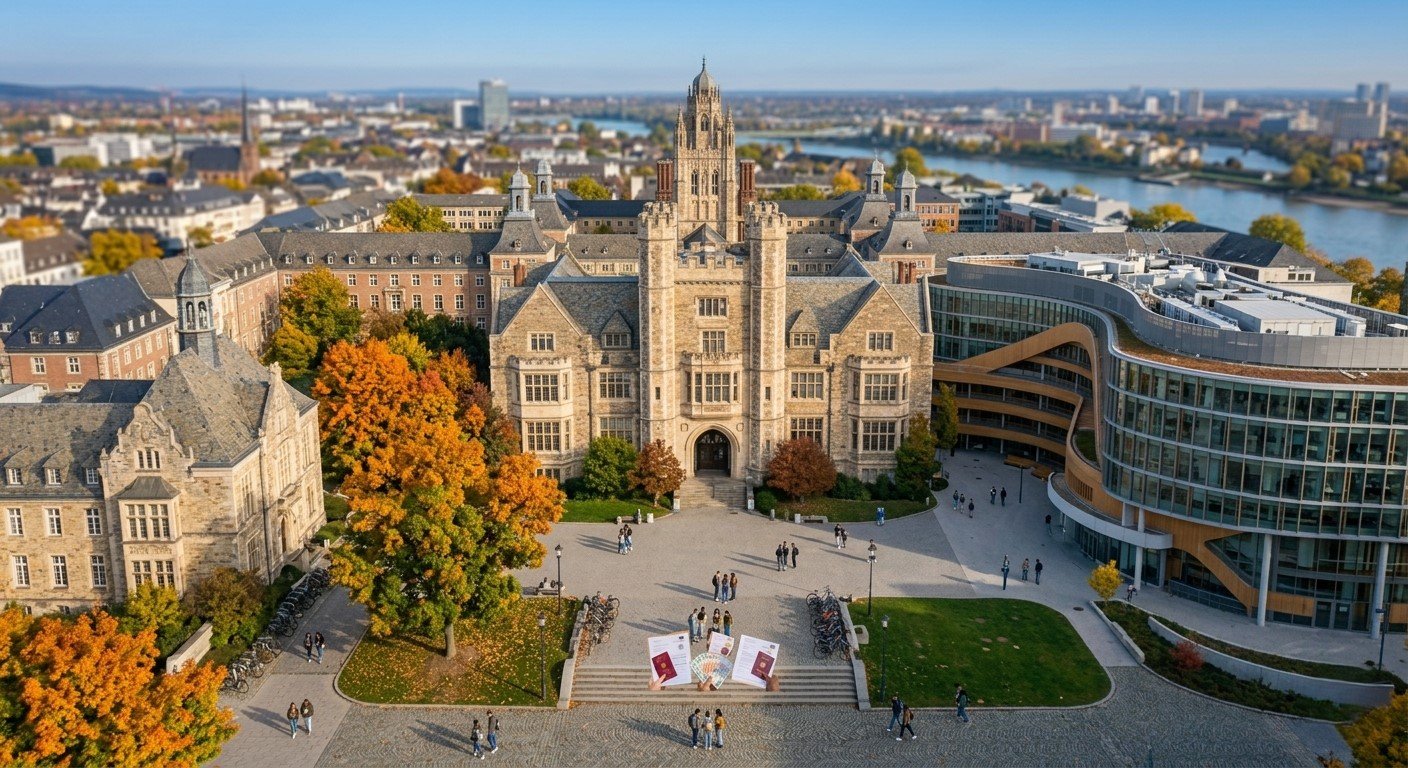
Germany is home to some of the world’s most prestigious academic institutions. The country’s commitment to funded public education allows international students to earn globally recognized degrees without heavy tuition burdens.
Understanding public higher education in Germany involves learning how public universities operate, satisfying strict qualification checks, and meeting official financial and administrative conditions set by German authorities.
Key Takeaways
- Tuition-Free Structure: Public universities across 15 of 16 German federal states do not charge tuition fees for international students pursuing Bachelor’s or consecutive Master’s degrees.
- Semester Fees (Semesterbeitrag): Students pay a mandatory fee between €100 and €400 per semester, which supports campus administration, student services, and local public transit passes.
- Financial Guarantee (Sperrkonto): International students from non-EU countries must deposit €11,904 into a blocked account, granting a monthly payout of €992 to cover living expenses.
- Qualification Verification: Secondary school certificates must be recognized through the Anabin database as equivalent to the German Abitur or balanced via a one-year Studienkolleg.
- Post-Graduation Opportunities: Non-EU graduates can extend their residence permit for up to 18 months to seek full-time professional employment within Germany.
Types of Public Universities in Germany
To navigate public higher education in Germany effectively, candidates must choose between different academic tracks based on their personal career goals.
Universities (Universitäten) vs. Universities of Applied Sciences (Fachhochschulen)
- Research Universities (Universitäten): Focus heavily on theoretical knowledge, academic research, and broad theoretical methodologies. They are ideal for students planning to pursue doctoral studies (PhD).
- Universities of Applied Sciences (Fachhochschulen / TH): Emphasize practical training, industry partnerships, and mandatory internships. Courses are structured to prepare graduates directly for the job market.
- Colleges of Art and Music (Kunst- und Musikhochschulen): Offer specialized programs focusing on creative disciplines, requiring talent auditions or portfolio submissions.
[External Link: Official DAAD Search Engine for Public University Programs]

Admission Requirements & Credential Verification
Getting accepted into a public institution requires proving academic readiness and meeting exact language prerequisites.
Secondary School Evaluation (HZB)
Your secondary qualification must match the German Higher Education Entrance Qualification (Hochschulzugangsberechtigung).
- Direct Entrance: Your foreign diploma qualifies you immediately for university registration.
- Indirect Entrance: You must enroll in a preparatory foundation year (Studienkolleg) and pass the Feststellungsprüfung (FSP) before joining your degree program.
Language Proficiency Standards
- German-Taught Programs: Require certified B2 or C1 proficiency through standardized tests like TestDaF or DSH.
- English-Taught Programs: Require standardized English certificates such as IELTS or TOEFL.
[Internal Link: Step-by-Step Guide to uni-assist Document Verification]

Financial Planning and Student Visa Steps
Proving your ability to cover basic cost-of-living expenses is required before you can secure your student entry visa.
| Financial Category | Amount | Notes / Description |
| Annual Blocked Deposit | €11,904 | Mandatory proof of funds deposited in a Sperrkonto. |
| Monthly Disbursement | €992 | Released each month into your local checking account (Girokonto). |
| Semester Fee | €100 – €400 | Paid directly to the university every term. |
| Statutory Health Insurance | ~€110 – €130 / month | Mandatory coverage for enrollment and residence permit. |

Frequently Asked Questions (FAQs)
Is public higher education in Germany completely free for non-EU students?
Yes, public universities in 15 of Germany’s 16 federal states do not charge tuition fees for most Bachelor’s and consecutive Master’s degrees, regardless of your country of origin. The main exception is Baden-Württemberg, which charges non-EU students €1,500 per semester.
How much money do I need to prove for a German student visa?
You must prove access to €11,904 per year (€992 per month), typically placed into a German blocked account (Sperrkonto) prior to your embassy appointment.
Can I work part-time while enrolled in public higher education in Germany?
Yes. Non-EU international students can legally work up to 140 full days (or 280 half days) per calendar year during their studies.
Conclusion
Understanding how public higher education in Germany functions gives you a massive advantage when planning your studies. By verifying your entrance qualifications early, budgeting for your blocked account, and organizing your application documents, you can secure your place at a world-class public university in Germany without tuition costs.